Rats and weasels infest camps for displaced Gazans
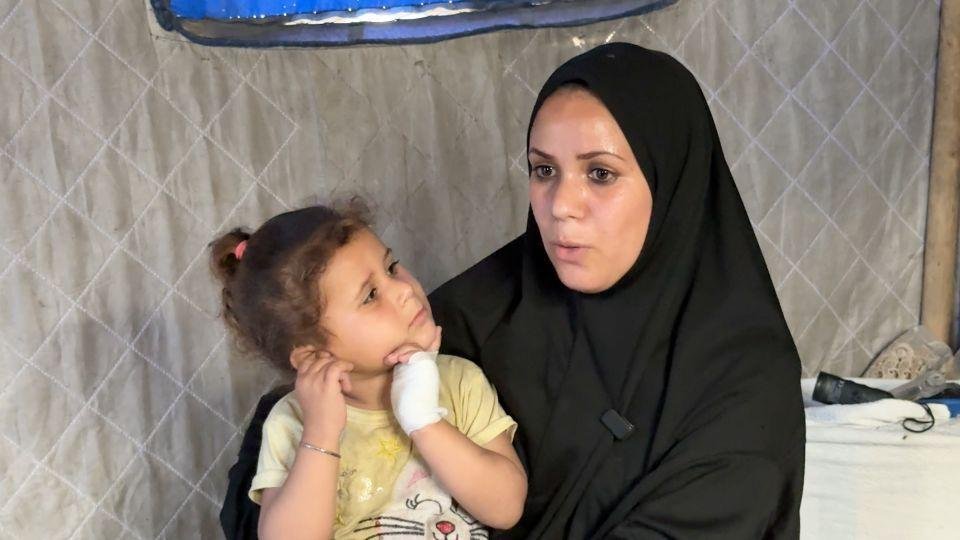
“We woke up to the sound of her screaming at 2am,” Samah al-Daabla, the mother of four-year-old Mayaseen, tells the BBC.
“When my husband turned on the torch, the weasel ran away. I looked at my daughter’s hand, and it was all blood. Everything was bloody.”
In the Gaza Strip, left devastated by war, the daily battles are now with rats, urban weasels and other pests spreading diseases.
Aid workers are calling for urgent steps to counter a public health crisis.
Cogat, the Israeli defence body that controls Gaza’s crossings, says it is working with international organisations “to address sanitation needs”.
Mayaseen was given a tetanus injection in a Gaza City hospital but suffered from days of fever and vomiting. She is now recovering in her family’s tent.
Social media feeds have recently shown footage of rats running amok in camps for displaced families, and of newborn babies, the sick and elderly after rodents have attacked them.
One grandmother with nerve damage to her feet caused by diabetes has spoken of having parts of her toes bitten off.

Aid workers warn of a public health crisis in Gaza [BBC]
In a recent survey, cited by UN agencies, rodents or pests were frequently visible in 80% of sites where displaced families are now living, affecting some 1.45 million people.
Rodents can harm people through bites and scratches as well as their urine, droppings and fleas. These can cause respiratory and skin diseases, blood infections and food poisoning.
The local World Health Organization (WHO) representative, Dr Reinhilde Van De Weert, says the new infestations are “unfortunately, the predictable consequence of a collapsed living environment”.
More than six months after the US brokered a Gaza ceasefire deal, it has failed to deliver hoped-for improvements in the humanitarian situation and progress appears to be stuck.
There are still regular deadly airstrikes in which Israel says it is targeting Hamas. Hamas, which triggered the Gaza war with its deadly assault on Israel and mass hostage taking in October 2023, has not committed to disarming.
No reconstruction has taken place. Gazans do not yet have any of the 200,000 caravans which Palestinian officials say they need as temporary homes.

Children get bitten by the pests which are thriving in piles of rubbish in Gaza [BBC]
With raw sewage water running through many overcrowded campsites, they have become breeding grounds for rodents. In the warmer springtime weather, the animals are thriving in the huge piles of rubbish which have accumulated next to people’s tents.
Many parents say they keep vigil at night to protect their children and belongings from invading animals.
“We cannot sleep! If we sleep, they bite the children and disturb us. There are so many weasels and rats – an abnormal number,” says Rizq Abu Laila, who lives right next to a rubbish dump in Gaza City with his four young children, one of whom has cancer.
“They go in the rubbish and fight because there are so many of them. I swear we can’t endure it. The rats have torn our clothes and eaten our flour. There are mosquitoes and foul smells. We call on international institutions to help us.”

The UN says “a very large-scale campaign” is needed to deal with waste and rubble in Gaza [BBC]
UN agencies say they are working on improvements in pest control, drainage and sanitation.
“What is needed is a very large-scale campaign to be able to deal with the waste and rubble problems across Gaza,” says the UN children’s agency Unicef’s deputy representative for Palestine, Ettie Higgins, in Deir al-Balah in central Gaza.
“Pipes have been destroyed, and treatment facilities have been destroyed so we are trying to scale up our support to manage the wastewater and sewage.”
Humanitarian workers want more heavy lifting equipment as well as spare parts for existing machines to clear away rubbish. They are also asking for access to Gaza’s major landfill sites which are in eastern parts of the strip now under full Israeli military control.
Ultimately, replacing damaged waste and sanitation facilities will need Israel to allow the entry of vital supplies from chemicals to pipes. It currently restricts these for security reasons, saying they could be used in the construction of new weapons by Hamas.
In a statement sent to the BBC, Cogat says that it “works in cooperation with the UN and the international community to enable a response in the fields of sanitation and essential infrastructure”.
“This includes coordinating the removal of waste piles, facilitating the entry of dedicated equipment for infrastructure repairs in accordance with requests and identified needs, and facilitating the entry of trucks and tankers for waste removal on behalf of the international aid organizations.
“In parallel, and in accordance with requests from the UN and international aid organizations, ongoing coordination is conducted to facilitate the removal of garbage, solid waste, and sewage in designated areas.”

Most of Gaza’s infrastructure has been destroyed since the start of the war [BBC]
Cogat says it has recently allowed humanitarian groups to take nearly 1,000 rat traps and almost 10 tons of pesticides into Gaza.
Some pest sprays have already been used in tent camps to combat the growing menace from bugs.
According to the WHO, there have been reports this year of some 111,500 cases of disease or infestation due to external parasites. These include scabies – caused by mites, lice and bed bugs. More than four-fifths of households in Gaza report skin infections and rashes.
Locals foresee that when summer comes, numbers of all pests are likely to rise, increasing the health hazards.
“I am now in a house with just the outside walls standing. We spend the whole night scratching from fleas on one side and mosquitoes on the other. There are weasels passing by or rats,” says Hassan Al-Faqaawi a father-of-six in Khan Younis in southern Gaza.
“We need something to deal with it. I don’t see any lasting peace at all in Gaza. Life is much harder that it was before. There is no life.”