Nikkei 225, Kospi, Hang Seng Index
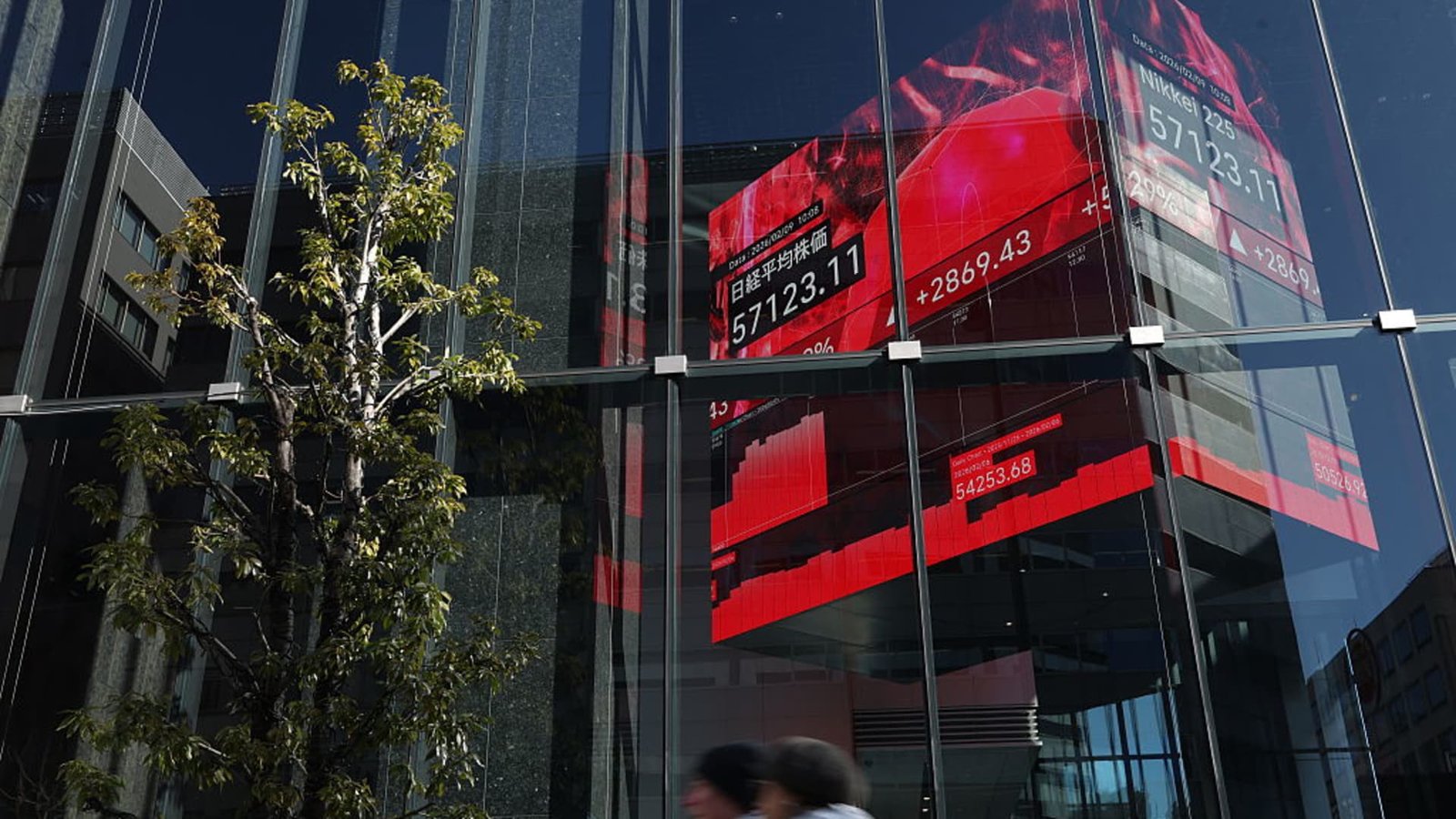
A screen displays Nikkei 225 Stock Average inside the Kabuto One building in Tokyo, Japan, on Monday, Feb. 9, 2026. Japanese stocks surged to fresh record highs, while bonds dropped, after Prime Minister Sanae Takaichi’s Liberal Democratic Party secured a landslide victory. Photographer: Kiyoshi Ota/Bloomberg via Getty Images
Bloomberg | Bloomberg | Getty Images
Asia-Pacific markets fell Monday as investors assess elevated oil prices and the latest developments in the escalating U.S.-Iran conflict.
U.S. crude prices topped $100 per barrel as the Trump administration weighs military strikes on Tehran’s Kharg Island, a strategically vital hub often referred to as Iran’s “oil lifeline.”
U.S. crude oil was trading flat at $98.7 per barrel by 8:10 p.m. ET. Brent prices, the international benchmark, were up 0.48% to $103.7 per barrel.
President Donald Trump on Friday ordered strikes against Iranian military assets on Kharg Island and warned of further attacks on crude facilities located there. Mike Waltz, the U.S. ambassador to the United Nations, repeated the warning Sunday.
Goldman Sachs estimates that the surge in energy prices stemming from the war in Iran could shave about 0.3% off global GDP over the next year, while pushing headline inflation higher by roughly 0.5% to 0.6%.
Higher natural gas prices are expected to add further inflationary pressure and growth headwinds, particularly in Europe and Asia, with risks skewed toward larger impacts if the Strait of Hormuz remains closed, the bank wrote in a note on Sunday.

Hong Kong’s Hang Seng index fell 0.3%, while the CSI 300 was down 0.31% even as China’s consumption and production both beat expectations on holiday spending and strong foreign demand.
Retail sales for the first two months of the year rose 2.8% from a year earlier, beating economists’ forecast for a 2.5% growth, but a notable slowdown from the 4% growth in the January-February period in 2025.
Industrial output climbed 6.3%, also exceeding expectations for a 5% jump in a Reuters poll. Industrial production has been a relative bright spot in the world’s second-largest economy, thanks to resilient external demand, particularly from European and Southeast Asian nations.
Japan’s Nikkei 225 fell 1.07%, while the Topix slid 0.98%. South Korea’s Kospi was unchanged, while the Kosdaq fell 1.72%.
Australia’s S&P/ASX 200 declined 0.44%.
Bitcoin gained over 3% to $73,844.20, while ether jumped 6% to $2,263.93. Bitcoin gained 5% last week, and is up roughly 10% since the Iran war started on Feb. 28.
Stock futures rose slightly as Wall Street tried to recover from another losing week.
Dow Jones Industrial Average futures added 153 points, or 0.3%. S&P 500 futures rose 0.3% and Nasdaq-100 futures gained 0.3%.
Last Friday, the three major U.S. averages fell. The S&P 500 shed 0.61%, putting it 5% below its recent high and closing at 6,632.19. The Nasdaq Composite declined 0.93% to end at 22,105.36. The Dow Jones Industrial Average shed 119.38 points, or 0.26%, and settled at 46,558.47.
— CNBC’s Anniek Bao, Sean Conlon and Pia Singh contributed to the report.