Artemis II sets new record as astronauts travel farther from Earth than ever before | Artemis II
Artemis II astronauts broke Apollo 13’s distance record at 1.57pm eastern time on Monday, hugging each other in the cramped capsule as they made history for being the first four humans to travel the farthest from Earth than anyone before them.
Before hitting the record, the quartet dimmed the lights in their capsule and positioned themselves by the windows in preparation to set the long-distance record as they fly by the moon without stopping – with plans to ultimately swing around for planet Earth.
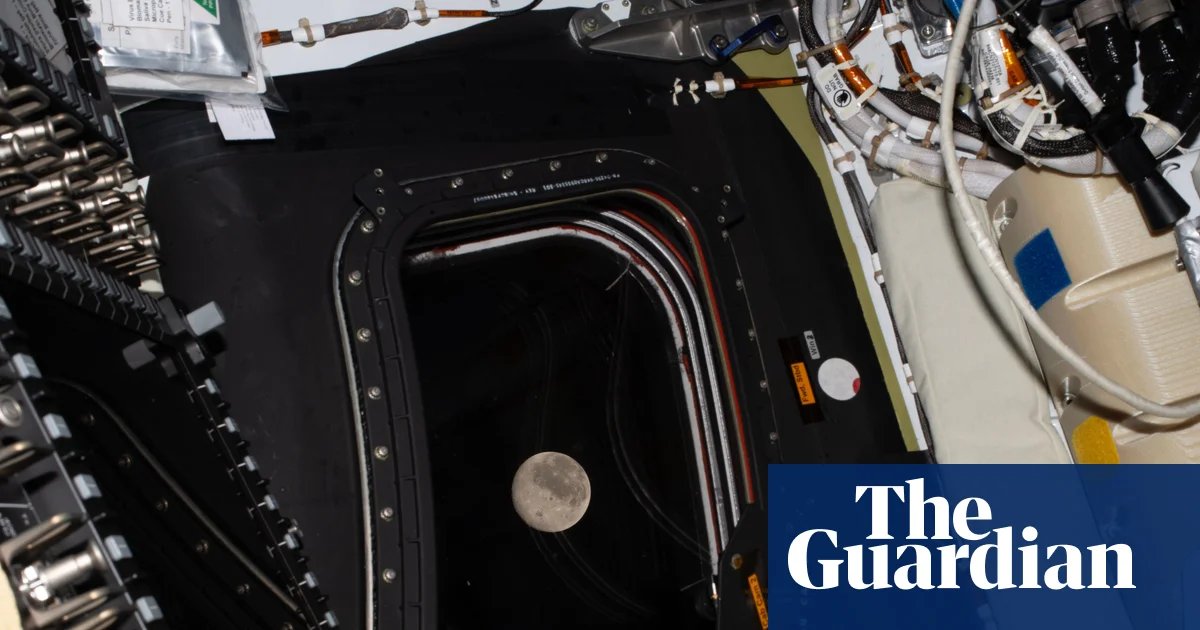
“It is blowing my mind what you can see with the naked eye from the moon right now,” Canadian astronaut Jeremy Hansen radioed ahead of the flyby. “It is just unbelievable.”
He challenged “this generation and the next to make sure this record is not long-lived”.
The astronauts – Reid Wiseman, Victor Glover and Christina Koch of the US space agency Nasa; and Hansen of the Canadian Space Agency – will become Earth’s farthest travelled, going 5,000 miles (8,000km) beyond the moon, exceeding the distance record set by the ill-fated Apollo 13 in 1970.
Astronauts on the emergency flyby in 1970 – commander Jim Lovell, Fred Haise and Jack Swigert – reached a maximum 248,655 miles from Earth before making their turn. Artemis’s crew should exceed Apollo 13’s mission by about 4,000 miles.
Hours after the Artemis quartet set that distance record, the capsule will pass on the far side of the moon, starting a communications blackout that is expected to last 40 minutes.
“We will see you on the other side,” said astronaut Victor Glover, minutes before the connection was lost.
Earlier Monday, Hansen said the astronauts had proposed naming a crater in honor of Wiseman’s late wife, who died of cancer in 2020 at the age of 46.
“It’s a bright spot on the moon, and we would like to call it Carroll,” Hansen said, in an emotional moment for the four astronauts, Agence France-Presse reports.
The report added that the astronauts also decided to name another crater “Integrity”, after their spacecraft.
According to a Nasa spokesperson speaking to Agence France-Presse, the proposed crater names will be submitted to the International Astronomical Union, which is responsible for naming celestial bodies.
Meanwhile, Koch described her experience of capturing the moon’s surface, saying: “I just had an overwhelming sense of being moved by looking at the moon … It lasted just a second or two, and I actually couldn’t even make it happen again. But something just drew me in suddenly to the lunar landscape, and it became real.”
“The truth is, the moon really is its own body in the universe – it’s not just a poster in the sky … It is a real place. And when we have that perspective and we compare it to our home of Earth, it just reminds us how much we have in common. Everything we need, Earth provides. And that is somewhat of a miracle, and one that you can’t truly know until you’ve had the perspective of the other,” she added.
On what is the sixth day of a lunar mission that has reinvigorated Nasa’s space exploration program, the Orion capsule’s roughly six-hour flyby on Monday promises views of the moon’s far side that were too dark or too difficult to see by the Apollo program astronauts who preceded them more than half a century ago.
A total solar eclipse also awaited them, with the moon blocking the sun, exposing snippets of shimmering corona. “We’ll get eyes on the moon, kind of map it out and then continue to go back in force,” the flight director, Judd Frieling, said.
Koch recently said that she and her Artemis II crewmates do not live on superlatives, but it was an important milestone “that people can understand and wrap their heads around”, merging the past with the present – and even the future when new records are set.
Orion was to be out of contact with mission control for 40 minutes when it is behind the moon. Nasa is relying on its Deep Space Network to communicate with the crew, but the giant antennas in California, Spain and Australia will not have a direct line of sight.
These communication blackouts were always a tense time during the Apollo missions although, as Frieling points out, “physics takes over – and physics will absolutely get us back to the front side of the moon”.
Once the capsule rounds the moon, it will take four days to return to Earth. Nasa is aiming for a splashdown in the Pacific Ocean near San Diego on 10 April, nine days after its Florida launch.
Kelsey Young, Nasa’s Artemis II lunar science geologist, said the Artemis II crew would survey potential landing zones for future missions, including the mysterious Reiner Gamma formation – a bright lunar swirl associated with a localized magnetic anomaly – and photograph Mercury, Venus, Mars and Saturn at sunrise and sunset.
Furthermore, they will attempt to recreate the Earthrise image, which was taken from lunar orbit by astronaut William Anders on 24 December 1968 during the Apollo 8 mission – and is credited with inspiring the environmental movement. There are hopes that the new photo can have the same unifying effect that the original did.