What we know about the chemical tank incident in Southern California — and what questions still linger
What sent a chemical storage tank in Garden Grove, California, to the verge of either leaking or blowing up? And how did authorities avoid the worst-case scenario — a massive vapor explosion that threatened to destroy buildings and expose residents to toxic plumes?
Subscribe to read this story ad-free
Get unlimited access to ad-free articles and exclusive content.

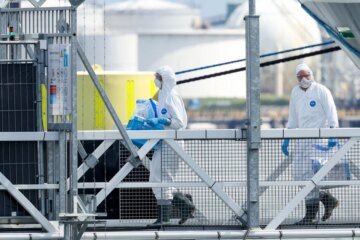
Over the last several days, Southern California officials — with help from state and federal agencies — have tried to avert what they feared could be one of the worst chemical incidents in California history. The emergency has forced officials to explain complicated chemistry dynamics to concerned residents who evacuated their homes with no scheduled return date.
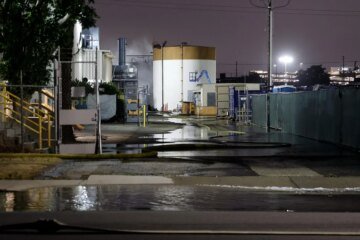
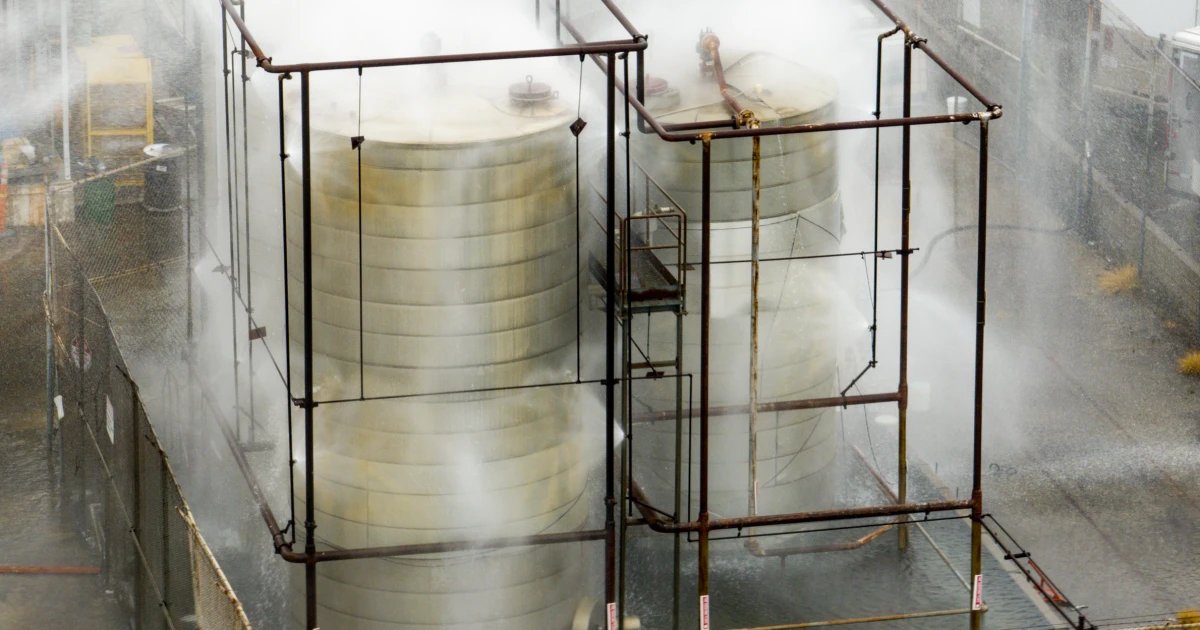
At issue is a storage tank at an aerospace facility containing approximately 7,000 gallons of liquid methyl methacrylate, a chemical used to manufacture resins and plastics. The Orange County Fire Department reported late last week that the tank had begun to heat up and bulge.
That meant one of two horrifying scenarios: Either the pressure in the tank would get so high that it would crack and the chemical would spill out, or the tank would rupture and the chemical would vaporize and explode. Experts feared the blast would cause two nearby tanks of methyl methacrylate to explode as well.
“That was what we were handed — a leaking tank or a tank that blows up,” Craig Covey, an Orange County Fire Authority division chief, said Friday.
Exposure to methyl methacrylate can cause eye or skin irritation, and inhaling it can lead to coughing, wheezing, dizziness, headache or shortness of breath.
By Monday morning, the fire department said it had eliminated the threat of a boiling liquid expanding vapor explosion, or BLEVE — a scenario in which flammable liquid inside the tank becomes hotter than its boiling point, creating so much pressure that the tank explodes, accompanied by a massive fireball.
Andrew Whelton, a professor of civil, environmental and ecological engineering at Purdue University in Indiana, compared the process to leaving a soda can in your car in the middle of summer.
“If you leave it in there, it’s going to blow up because the pressure in the soda can get too great,” he said. However, “if you put a hole in it, it will let some of the gases out.”
Southern California officials confirmed Monday that a crack in the tank was releasing pressure and that the internal temperature was coming down. Firefighters have also been using sprinklers and hose lines to cool the tank. At least 50,000 people in the area remain under evacuation orders.
At its peak, the tank reached at least 100 degrees Fahrenheit — the highest reading on the temperature gauge, suggesting the actual temperature may have been even higher. The boiling point for methyl methacrylate is around 212 degrees, according to BASF, a large chemical manufacturer. By Monday, the temperature had dropped to 93 degrees.
“The fact that it is decreasing is a positive sign because it means that there’s no heat being generated inside that chemical tank,” Whelton said.
However, he said the risk of a chemical spill or smaller explosion isn’t off the table, given the lingering uncertainties about what’s happening inside the tank. Some chemical engineers think it’s possible that the methyl methacrylate inside the tank reacted with itself, creating a chain of molecules that bind together like Legos to become solid.
“Once it’s in that condition, it doesn’t pose a threat anymore, so that’s one of the theories about why the temperature is decreasing,” Whelton said.
Interim Orange County Fire Chief TJ McGovern said Monday on a press call that authorities are “very confident it’s solidifying, but we don’t know how much of it has yet.”
Over the weekend, McGovern said air monitoring had not detected any toxic air release. The crack is at the top of the tank, which, Whelton said, could in theory allow vapor and gases to escape.
On Monday, President Donald Trump approved California’s request for a presidential emergency declaration to free up more resources, such as equipment and personnel, from the Federal Emergency Management Agency. California Gov. Gavin Newsom also declared a state of emergency in Orange County on Saturday.
A White House official said FEMA has sent a team to the State Emergency Operation Center and activated its Interagency Modeling and Atmospheric Assessment Center, which models airborne hazards. The Environmental Protection Agency has enabled air monitoring at 20 locations around the area, the official said.
But there’s still the question of what caused the tank to heat up in the first place. The Orange County District Attorney’s Office has launched an investigation into the incident, and two Garden Grove residents have filed a class action lawsuit against GKN Aerospace, the company that owns the facility.
In response to a request for comment, a spokesperson for GKN Aerospace directed NBC News to an online statement saying that its technical specialists worked with the Orange County Fire Authority to stabilize the tank.
“The team safely and successfully removed external insulation material from the tank in order to help advance efforts to cool its contents,” the statement reads. It continues: “We apologize for the ongoing disruption this incident is causing and our priority remains its safe resolution, so that residents can return to their homes as quickly as possible.”
Craig Covey, the Orange County fire incident commander, said Friday that authorities were able to neutralize a nearby tank by adding a compound to it, but couldn’t do the same for the one on the brink of exploding because the valves were “broken” and “gummed up.”
“This is why you need environmental regulators to do inspections. A fair question for EPA and the South Coast Air Quality Management District is, when is the last time this particular tank was inspected, and what was found?” said Judith Enck, a former EPA regional administrator who is now president of Beyond Plastics, a nonprofit trying to end plastic pollution.
Whelton said investigators should consider how often the tank was maintained or cleaned out, or whether the chemical itself had solidified and clogged the valves.
“Hopefully it’s going to turn out to be just a giant emergency for many people involved, the chemical is not released and there is no physical destruction of buildings,” he said. “That’s the ideal situation, and that’s still in the cards.”