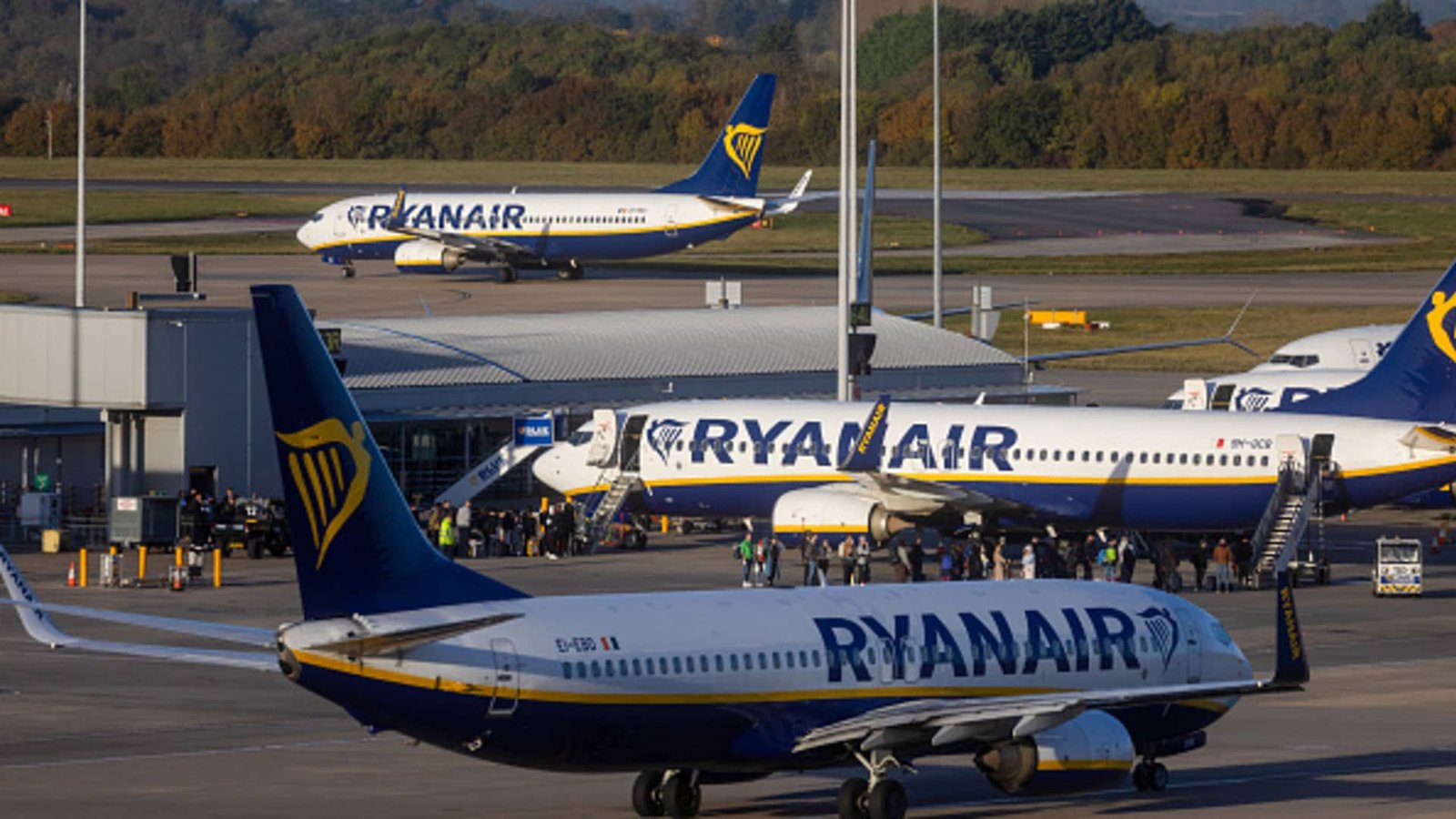
Ryanair CFO warns weaker European carriers may not survive jet fuel crunch
Ryanair has prepared for an “armageddon situation,” amid the jet fuel crisis, the budget airline’s chief financial officer told CNBC Monday.
“Do we have plans for some kind of Armageddon situation? Of course, we do, but I don’t see that coming to pass. As things stand, we’re operating a full schedule this summer, and plan to operate a full schedule into the winter period,” Neil Sorahan told CNBC’s Ritika Gupta in an interview.
“I think we will see some of the weaker carriers who were already struggling before the war possibly go to the wall in the winter,” Sorahan said.
Shares closed up 6% on Monday after the airline reported full-year earnings. The stock is down around 22% year-to-date.
The carrier has hedged 80% of its summer fuel at $668 per metric ton, citing “economic uncertainty” caused by the Middle East conflict and the ongoing blockade of the Strait of Hormuz. The 20% of unhedged fuel has “spiked” due to the volatility of prices. Sorahan said the airline is “not planning for cancelations.”
He told CNBC that he wouldn’t be surprised in the winter to see some European airlines “getting themselves into trouble,” in a similar scenario that occurred with Spirit Airlines in the U.S. The airline collapsed after the jet fuel crisis added to its longstanding issues, including heavy debt loads and a surge in costs.

“We’re in obviously very volatile oil markets at the moment. If we go back a couple of months ago, we probably had some concern around oil supply, but we’re increasingly confident that there won’t be issues in relation to oil into this summer,” Sorahan said.
He explained that Ryanair is not “overly concerned” about jet fuel supply as Europe’s dependence on the Strait of Hormuz is declining, with suppliers now getting oil from the likes of the U.S., Venezuela, and Brazil, among others.
“That said, I think prices will remain higher for longer, which puts Ryanair in a particularly strong position, given our strong fuel hedging,” Sorahan said.
Ryanair CEO Michael O’Leary forecasted “real failures” for other airlines if the price of jet fuel remained elevated, in a conversation with CNBC in April.

“I think there will be failures,” O’Leary said. “If it continues at $150 a barrel into July, August, September, then you’ll see European airlines fail and that, in the medium term, would probably be good for Ryanair’s business.”
How did Ryanair fare in its earnings?
Ryanair reported a 40% increase in profit after tax to nearly 2.3 billion euros ($2.7 billion) in the year ending in March, while passenger traffic grew 4% to 208.4 million. Meanwhile, its revenue fell 11% to 15.54 billion euros.
While it had originally expected summer fares to rise slightly, it’s now forecasting it to be broadly flat, with the final outcome dependent on last-minute bookings during peak travel periods. The airline said there’s been an increase in later bookings, which has reduced visibility.
Ryanair has had to lower prices to attract customers in early summer, but prices are going to look similar to last year in the company’s second quarter, Citi analysts said in a note Monday.
“The company indicates S26 [Summer 2026] travel demand is ‘robust’ but bookings are closer in than usual and pricing has eased in recent weeks on economic uncertainty relating to fuel prices, inflation, and fuel shortage fears,” the analysts said.
While Ryanair has no plans to include a fuel surcharge, Sorahan told CNBC: “We haven’t promised no price increases. Ryanair operates a load active yield passive strategy, which means we price to fill the planes, and the consumers pretty much decide what that pricing is going to be.” He added that 700 million people a night are booking flights with Ryanair.
As holidaymakers in Europe and the U.K. deal with continuing uncertainty around the jet fuel crisis, many are now planning to travel via rail this summer or take short-haul flights, with Southern Europe expected to be the favoured destination.