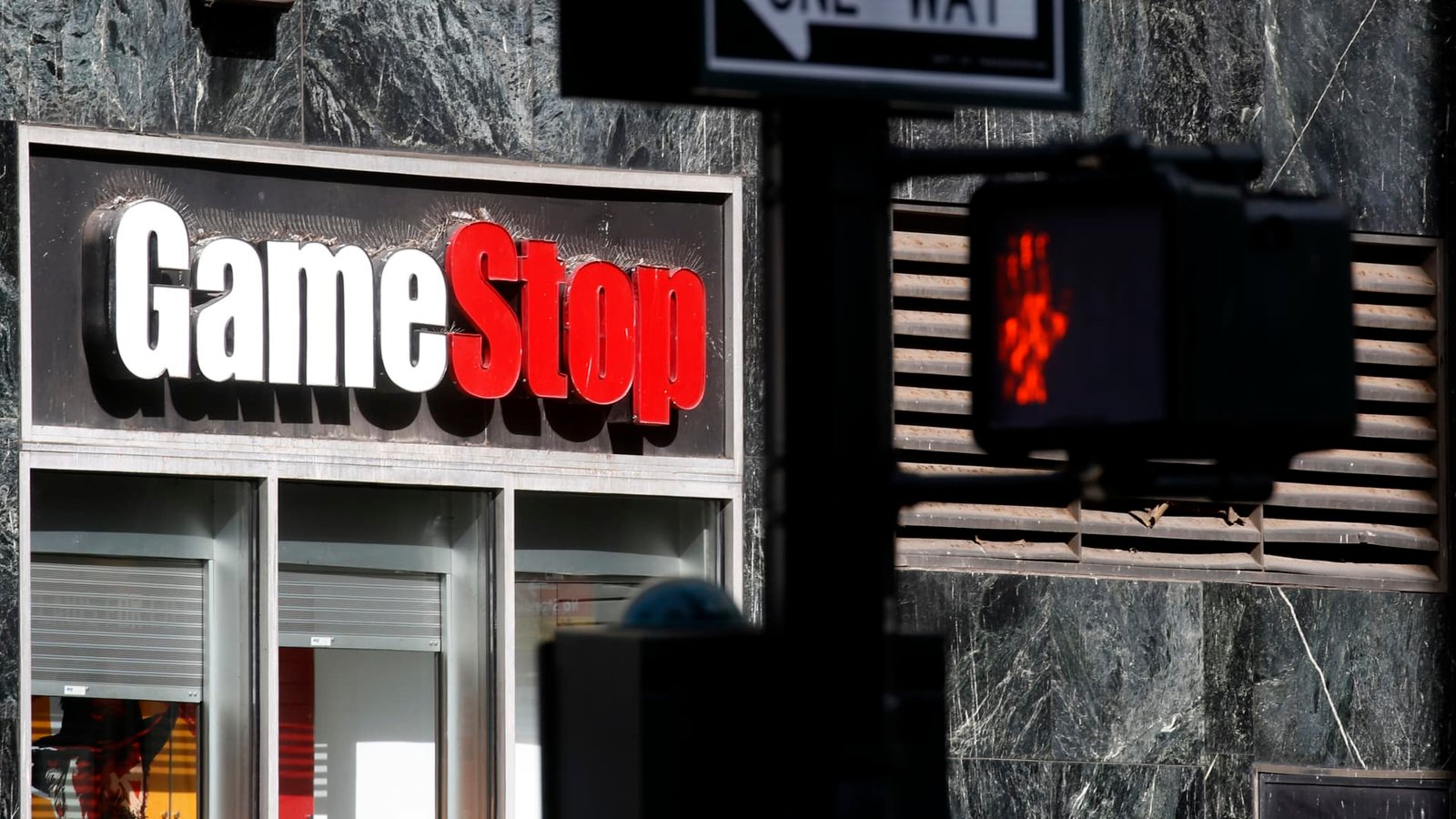
GameStop could issue stock for eBay takeover

Video game retailer GameStop announced Sunday it has made an unsolicited, nonbinding offer to acquire eBay for $125 per share in a cash-and-stock deal, valuing the e-commerce platform at roughly $55.5 billion.
The offer, split evenly between cash and GameStop common stock, represents a 20% premium to eBay’s Friday close of $104.07, and a 46% premium to its closing price on Feb. 4 — when the gaming retail giant started building a stake in the company, GameStop said in its statement.
Shares of eBay climbed about 5% on Monday to around $109, well below GameStop’s $125 offer, suggesting investors are skeptical the deal will close. GameStop’s current market value is just below $12 billion, while eBay’s is $46 billion.
GameStop stock sank 10%.
GameStop CEO Ryan Cohen told CNBC on Monday that he hasn’t started any conversation with eBay’s management.
“We are just starting,” Cohen said on CNBC’s “Squawk Box.” “For obvious reasons, eBay is a public company, there’s all kinds of perverse financial incentives from the board to the management team. So there’s only one way to approach something like this.”
EBay confirmed that it received the offer in a statement Monday, and said its board would review it.
The proposal raises immediate questions about financing. GameStop’s market value is only a fraction of the roughly $56 billion implied deal size, and while the company has lined up a $20 billion financing letter from TD Bank, the funding gap remains substantial.
Cohen offered limited clarity on the structure during what at times was a combative and awkward interview, repeatedly directing viewers to the company’s website for details.
“We are offering half cash, half stock, and we have the ability to issue stock in order to get the deal done. But the full details of the offer are on our website,” Cohen said. “We will see what happens.”

eBay
GameStop has accumulated roughly a 5% stake in eBay, consisting primarily of derivatives alongside some common stock, according to Cohen. The remainder of the deal would be funded from its approximately $9.4 billion cash pile as well as the possibility of issuing additional shares.
“It makes us one of the largest shareholders. So they have a fiduciary duty to their shareholders to evaluate this proposal,” Cohen said. “This is a business that is under-earning and can make a lot more money. And GameStop is a good blueprint for that.”
GameStop became a so-called “meme stock” during a 2021 retail frenzy that drove sharp gains in its shares.
Cohen added that eBay’s earnings power could increase materially under tighter cost controls, arguing earnings could potentially double over a relatively short period.
“It’s also going to be making a lot more money in the future than it is today because it’s going to be run a lot more efficiently,” Cohen said. “When a business is not growing users and spending $2.5 billion in sales and marketing, there’s a lot of fat to cut … it’s a business that can take on more leverage because it’s going to be making more money in the future.”
When pressed on what evidence he has that he can grow a mature consumer business, Cohen pushed back sharply on skepticism around GameStop’s own trajectory.
“Didn’t you guys call for GameStop’s demise multiple times? Like, it should have been bankrupt by now?” he said. “Look at our financial performance. Is it better than you guys anticipated? Because you guys said it was going to be doing really, really poorly, and it’s actually doing okay.”
The Wall Street Journal first reported on the unsolicited deal. Cohen told the Journal he is prepared to take the offer directly to shareholders in a proxy fight if necessary. Should the deal close, Cohen is expected to serve as Chief Executive Officer of the combined company, according to GameStop’s statement.

The proposal is subject to approval from eBay’s board of directors, regulators, and shareholders from both companies. EBay did not immediately respond to a CNBC request for comment.
Both companies have struggled to adapt to shifting consumer preferences, and it remains unclear whether eBay’s board will view GameStop — whose own market capitalization stood at roughly $11 billion before the news broke — as a credible acquirer for a company four times its size.
Cohen first hinted in January at plans to acquire a publicly traded consumer company larger than GameStop, telling CNBC at the time that the deal would be “transformational” and “never been done before within the history of the capital markets.”
“It’s gonna be really big. Really big. Very, very, very big,” Cohen said of the size of the acquisition.
The Canadian entrepreneur built his reputation by founding Chewy, an online pet supply retailer that was sold to PetSmart for $3.35 billion in 2017. He later gained a cult following after building a large GameStop stake, and in late 2020, criticized the company for moving too slowly toward e-commerce, arguing that the video-game retailer could reposition itself as the Amazon of the gaming industry.
He joined GameStop’s board in January 2021, just as retail traders on Reddit’s WallStreetBets forum rallied behind the stock, sending shares 1,500% higher in two weeks, in one of modern markets’ most chaotic episodes.
Cohen stepped up as CEO in September 2023, steering the company back to profitability through aggressive cost cuts and the closure of hundreds of stores.
In its offer, GameStop said it would cut $2 billion in annual costs within a year, targeting eBay’s bloated sales and marketing budget, which totaled $2.4 billion in fiscal 2025 while net active buyer growth remained flat at less than 0.75%.
“More spend is not producing more users on a marketplace with near-universal brand recognition,” the statement said.
The company projected that cost reductions alone would lift eBay’s earnings per share, measured under standard U.S. accounting rules, to $7.79 from $4.26 in the first year.
GameStop also pitched its roughly 1,600 U.S. retail stores as physical infrastructure for eBay’s marketplace, offering a network for authentication, intake, fulfillment, and live commerce capabilities.
Cohen’s compensation package, adjusted at the beginning of the year, also gave him an additional incentive to boost the company’s market value and profitability.
In January, GameStop outlined a compensation package for Cohen comprising stock options tied to performance targets, including market capitalization and earnings thresholds. Based on the structure, the options could be worth more than $35 billion if the company reaches a $100 billion valuation and meets profit targets.
EBay, meanwhile, has faced increased competition in e-commerce from rivals such as Amazon, Walmart and Etsy, as well as newer, China-linked marketplaces such as TikTok Shop, Temu and Shein. After peaking at $100 billion in gross merchandise volume in 2020, eBay’s GMV slid to $79.6 billion in 2025, as the platform struggled to retain shoppers.
To keep buyers and sellers returning to its site, eBay CEO Jamie Iannone has pushed the company to lean into so-called “focus categories,” such as trading cards, collectibles, used luxury goods and auto parts. In February, eBay said it would acquire Etsy’s secondhand clothing app Depop for about $1.2 billion in cash, giving it an edge into younger consumers.
EBay has also invested in artificial intelligence tools to make it easier for sellers to list their wares, and to help consumers find products on the site, including announcing a partnership with OpenAI for its agentic web browser.
As it spends more on AI, eBay has looked to trim its head count. The company in February laid off about 800 employees, or roughly 6% of its workforce.
Bernstein analysts wrote in a note to clients on Friday that while there is overlap between GameStop’s and eBay’s businesses in games, toys and collectibles, the strategic rationale for such a deal remains unclear. They added that Iannone’s tenure has had its “ups and downs,” but “recent execution has been solid.”
“Why disrupt things?” the firm wrote. “The turnaround is working.”