Iran says talks continue while it retains control of Strait of Hormuz

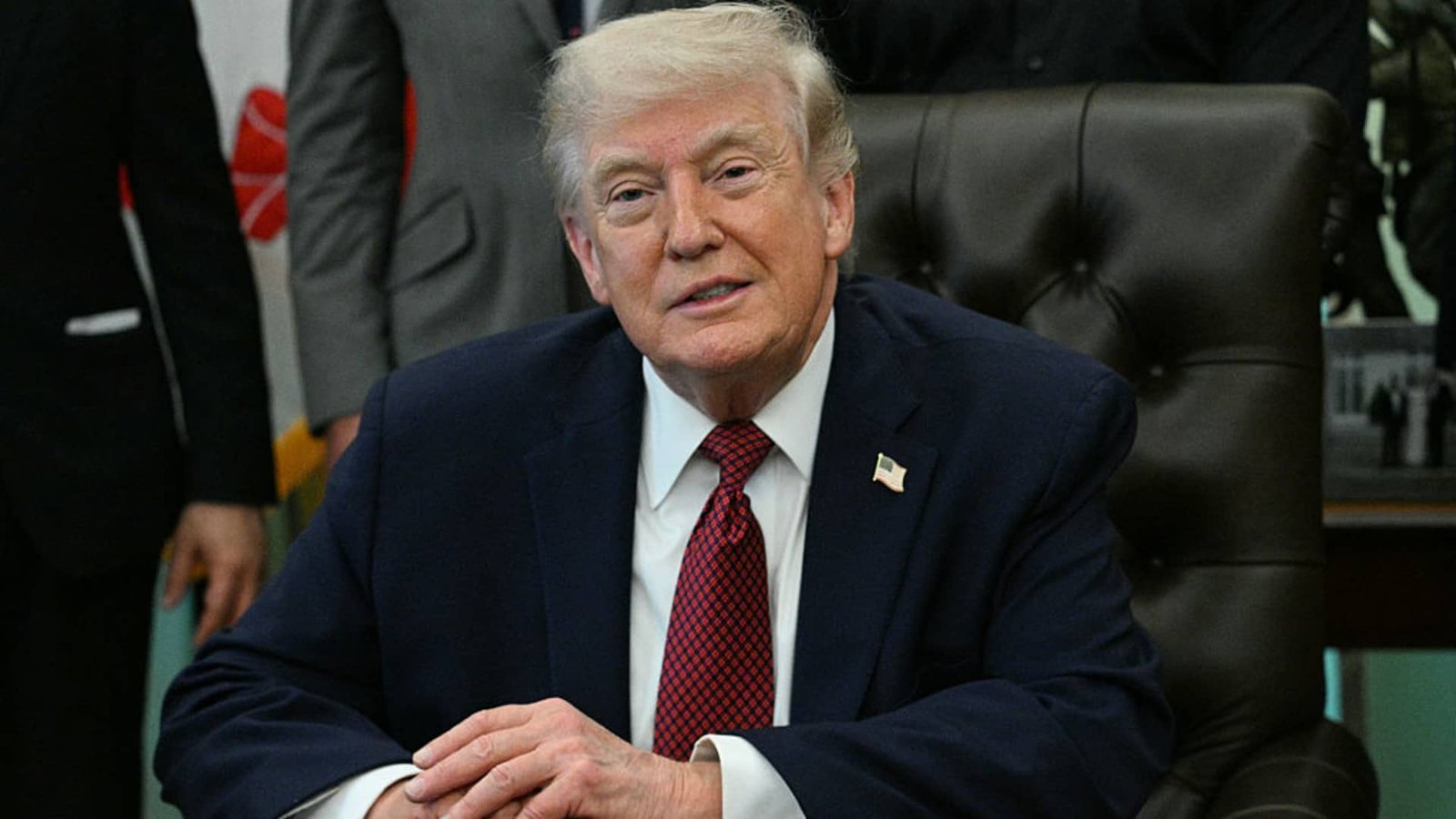
President Donald Trump said U.S. negotiators will head to Pakistan on Monday for a second round of peace talks with Iran.
“My Representatives are going to Islamabad, Pakistan — They will be there tomorrow evening, for Negotiations,” Trump said in a post on Truth Social on Sunday.
The president also claimed Iran violated a ceasefire that’s due to end on Wednesday.
“We’re offering a very fair and reasonable DEAL, and I hope they take it because, if they don’t, the United States is going to knock out every single Power Plant, and every single Bridge, in Iran. NO MORE MR. NICE GUY!
The U.S. delegation to Pakistan will once again be headed by Vice President JD Vance, two senior U.S. officials told MS Now.
Earlier Saturday, in a telephone interview, Trump told MS NOW that the vice president would not be leading the second round of talks due to security concerns, as Secret Service wouldn’t have enough time to secure the area before the vice president’s arrival.
Envoys Steve Witkoff and Jared Kushner, Trump’s son-in-law, also will be traveling to Islamabad for the talks, according to the White House said.
Pakistan’s Foreign Minister Mohammad Ishaq Dar spoke by phone with his Iranian counterpart on Sunday, ahead of a new round of negotiations between the United States and Iran.
The Pakistani foreign ministry said Dar discussed with Iran’s Foreign Minister Abbas Araghchi “the need for continued dialogue and engagement as essential to resolving the current issues as soon as possible.”
According to the ministry, Iran’s president will speak by phone with Pakistan’s prime minister later Sunday.
Meanwhile, the Pakistan capital is once again locking down in preparation for the high-stakes talks. Two giant U.S. C-17 cargo planes landed at Pakistan’s Nur Khan air base on Sunday afternoon carrying security equipment and vehicles in preparation for the U.S. delegation’s arrival, two Pakistani security sources said.
City authorities in the capital Islamabad halted public transport and heavy goods traffic through the city. Rolls of barbed wire were rolled out near the Serena Hotel where last week’s talks were held. The hotel told all guests on Sunday to leave.
Iran ratchets up rhetoric
Iran’s parliament speaker and top negotiator, Mohammad Bagher Ghalibaf, said talks to end the war with the U.S. and Israel are continuing but that his country stands ready to resume the conflict and warned the U.S. against using a naval blockade in the strait.
“It is not the case that we think just because we are negotiating, the armed forces are not ready,” Mohammad Bagher Ghalibaf said in televised remarks late Saturday according to a report on Iranian state media. “Rather, just as the people are in the streets, our armed forces are also ready.”
Ghalibaf also reiterated Iran’s intentions to restrict traffic through the strait, a key energy chokepoint.
“It is impossible for others to pass through the Strait of Hormuz but not us. If the U.S. does not abandon the blockade, traffic in the Strait of Hormuz will certainly be restricted,” he said.
Trump announced the blockade on April 12, after complaining that Tehran has not appeared to reopen the strait, one of his conditions for agreeing to the fragile two-week ceasefire that is currently in effect.
Gunboat diplomacy
Two gunboats from Iran’s Revolutionary Guard opened fire on a tanker transiting the strait, the British military’s United Kingdom Maritime Trade Operations center said Saturday. It reported the tanker and crew as safe, without identifying the vessel or its destination.
Shipping sources told Reuters at least two other vessels reported coming under fire while trying to transit the waterway.
The confusion over the strait’s status has left ship operators in a state of limbo.
Video footage from ship-tracking firm Kpler showed that several tankers and cargo ships attempted to exit the waterway on Friday but turned back.

Oil prices plunged more than 10% on Friday to below $90 per barrel on hopes that energy supplies would start flowing again from the region. About a fifth of the world’s crude supplies passed through the strait before the war. The closure of the sea lane connecting the Persian Gulf to global energy markets has triggered the largest oil supply disruption in history.
In Mumbai, India summoned Iran’s ambassador after an Indian-flagged vessel carrying crude oil was attacked while trying to cross the strait, Reuters reported.
In a White House event on Saturday, Trump declined to take reporters’ questions about Iran but said, “We have very good conversations going on.”
He said Iran “got a little cute,” later adding, “They wanted to close up the strait again,” referring to the Strait of Hormuz.
“They can’t blackmail us,” Trump said.
Iran rebuilds stockpile of missiles and drones
A senior Iranian military official said Iran has begun rebuilding its stockpile of weapons and munitions as the two-week ceasefire nears to expire, state media reported.
Brig. Gen. Seyed Majid Mousavi, commander of the Revolutionary Guard’s Aerospace Force, said they have repaired missiles and drone launchers during the ceasefire which started on April 8, according to Islamic Republic of Iran Broadcasting.
“Our speed in updating and refilling missile and drone launch platforms is even greater than before the war,” he said.
The broadcaster aired a two-minute video paired with uplifting music, showing missiles and drones in warehouses as well as mobile launches of missiles.
The United States and Israel say they have degraded Iran’s military capabilities over the course of the nearly six-week war.
Nuclear rights
Meanwhile, Iranian President Masoud Pezeshkian was quoted as saying the U.S. can’t deprive Iran of its rights to a nuclear program.
“Trump says Iran cannot make use of its nuclear rights but doesn’t say for what crime. Who is he to deprive a nation of its rights?” Reuters quoted Pezeshkian as saying via the Iranian Student News Agency.
In an interview with the Associated Press on Saturday on the margins of a diplomacy forum in Turkey, Iranian Deputy Foreign Minister Saeed Khatibzadeh said his country will not hand over its enriched uranium to the United States, rejecting claims made by Trump.
“I can tell you that no enriched material is going to be shipped to United States,” Khatibzadeh said. “This is non-starter and I can assure you that while we are ready to address any concerns that we do have, we’re not going to accept things that are nonstarters.”
Trump on Friday said that Iran had agreed to hand over its stockpile of enriched uranium.
He also said the U.S. will go into Iran and “get all the nuclear dust,” referring to the 970 pounds (440 kilograms) of enriched uranium believed to be buried under nuclear sites badly damaged by U.S. military strikes last year.
Peace talks in the Pakistani capital, Islamabad, between a U.S. delegation led by Vice President JD Vance and Iranian negotiators headed by Ghalibaf failed to reach an agreement last weekend.
Iran’s Supreme National Security Council said in a statement that Pakistan’s army chief, serving as an intermediary, presented the proposals to Iran during his recent visit to Tehran, and that they were still under review.
It was not revealed what was in the proposals.
‘Excessive demands’
The council said Iran has yet to respond, but further talks would require the U.S. to abandon “excessive demands and adjust its requests to the realities on the ground.”
Iranian Foreign Minister Seyed Abbas Araghchi on Friday said on social media: “In line with the ceasefire in Lebanon, the passage for all commercial vessels through Strait of Hormuz is declared completely open for the remaining period of ceasefire.”
However, vessels must transit through a “coordinated route” announced by Iran’s maritime authorities, Araghchi said. It is unclear whether Tehran will force ships to pay a toll to pass the strait.
Israel and Lebanon agreed Thursday to a 10-day ceasefire starting at 5 p.m. ET that evening. Israel’s military campaign in Lebanon against the militant group Hezbollah, which is a close ally of Iran, has been another hurdle in negotiations between Washington and Tehran.
— The Associated Press and Reuters contributed to this report.