Middle East crisis live: Trump casts doubt on Iran war ceasefire over continued closure of strait of Hormuz | US-Israel war on Iran
Summary
Welcome to the Guardian’s continuing coverage of the crisis in the Middle East.
The fragile ceasefire between the US and Iran showed further strain on Friday, a day before delegations from both countries are due to meet in Pakistan, as Donald Trump accused Tehran of breaching promises on the strait of Hormuz and Israel struck Lebanon with attacks that Iran claims violate the truce.
Trump said in a social media post late Thursday that Iran was doing a “very poor job” of allowing oil to go through the strait. “That is not the agreement we have!”
There is no sign Iran is lifting its near-total blockade of the strait, which has caused the worst-ever disruption to global energy supplies. Tehran cited Israel’s ongoing attacks on Lebanon, which included the heaviest strikes of the war on Wednesday, as a key sticking point.
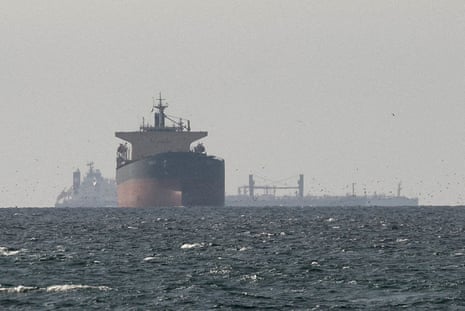
In the first 24 hours of the ceasefire, which Trump announced on Tuesday, just a single oil products tanker and five dry bulk carriers sailed through the strait, which typically carries a fifth of the world’s oil and liquefied natural gas flows and 140 ships a day before the war.
-
Donald Trump has said he is “very optimistic” a peace deal with Iran was within reach as a diplomatic delegation led by his vice-president JD Vance prepared to head to Pakistan for high-stakes talks aimed at ending the war this weekend. Iran’s leaders “talk much differently when you’re at a meeting than they do to the press. They’re much more reasonable,” the US president said, in line with his administration’s narrative that there’s a disconnect between what Tehran says publicly and privately.
-
Trump also confirmed that he had asked Benjamin Netanyahu on Wednesday to be “more low-key” in Lebanon to help ensure the success of the upcoming US-Iran negotiations in Islamabad. “I spoke with Bibi and he’s going to low-key it. I just think we have to be sort of a little more low-key,” Trump told NBC News, adding that he believed Israel was “scaling back” its operations in Lebanon.
-
Netanyahu said he had instructed his cabinet to begin direct negotiations with Lebanon aimed at disarming Hezbollah – all the while insisting that “there is no ceasefire” in Lebanon and that Israel will “continue to strike Hezbollah with force”.
-
Israel has since launched a fresh wave of strikes against what it called “Hezbollah launch sites” in Lebanon, after the IDF earlier ordered people to flee Beirut’s densely populated southern suburbs. Later in the day, Hezbollah said it had fired a rocket salvo towards northern Israeli settlements.
-
While Israel continues to insist that the war will go on and “talks will be held under fire”, Lebanon is demanding a ceasefire before direct negotiations can begin. Joseph Aoun, the Lebanese president, said this was “the only solution”. Lebanon is also insisting that it needs the US as a mediator and guarantor of any agreement. Those talks will take place next week, hosted by the US state department in Washington.
-
Iran’s president Masoud Pezeshkian said Israeli strikes on Lebanon violate the ceasefire agreement and would render negotiations meaningless, adding that Iran would not abandon the Lebanese people.
-
The speaker of the Iranian parliament, Mohammad Bagher Ghalibaf, said Lebanon forms “an inseparable part of the ceasefire” deal. In a post on X, he said “there is no room for denial and backtracking”.
-
Keir Starmer also said that Israel’s continued attacks on Lebanon “shouldn’t be happening”. The British prime minister also dismissed an argument put forward by US vice-president JD Vance on Wednesday that there had been “a legitimate misunderstanding”, saying the issue “isn’t a technical one of whether it’s a breach of the agreement or not”. It is “a matter of principles as far as I’m concerned”, Starmer said.
-
A statement attributed to Mojtaba Khamenei, Iran’s supreme leader, said Iran will take management of the strait of Hormuz into a new phase, but did not elaborate on what that would be. In the statement, read out on state tv, he also said Iran remains determined to “take revenge” for his father, who was assassinated on the first day of the war, and all those killed in the war. “We will certainly demand compensation for each and every damage inflicted, and the blood price of the martyrs and the compensation for the wounded of this war,” he said.
Key events
Saeed Shah
Gulf states rethink security in light of US-Israel war on Iran
Gulf nations will seek to add security partners as they rebuild battered economies after the US and Israel’s war on Iran and deal with an emboldened Tehran.
The Gulf will have to live with a continuing threat from the regime in Iran and its remaining missile arsenal. American bases on their soil turned them into targets for Iran, as it retaliated against a joint attack by the US and Israel.
But, the countries say they can’t tolerate Iran keeping control of the strait of Hormuz, through which most of their trade flows. In agreeing to a ceasefire this week, Iran insisted it would retain the hold it took during the war over the waterway, which would allow Tehran to throttle the Gulf at will. The future of the strait will be one of the main disputes to be negotiated between the United States and Iran, in talks in Islamabad due to start as soon as Friday.
Gulf nations trumpeted success in largely intercepting the Iranian barrage of missiles and drones over the five weeks of the conflict, showing they can defend themselves.
The countries are, however, split over future relations with Iran, with a hawkish grouping led by the United Arab Emirates and Bahrain taking a harder line, and other nations hoping for peace through renewed ties with Tehran, experts say.
Read the full report here:
The Israeli military has claimed to have destroyed more than 200 Hezbollah rocket launchers since the start of the conflict.
The Israel Defense Forces (IDF) said in a statement online that it destroyed more than 200 rocket launchers, including approximately 1,300 launch tubes, belonging to the Iran-backed militant group since 2 March.
Keir Starmer said he used a call with Donald Trump to set out the views of Gulf states, the Press Association reported.
“I had a discussion with president Trump last night and set out to him the views of the region here, these Gulf states are the neighbours of Iran, and therefore, if the ceasefire is to hold – and we hope it will – it has to involve them,” the UK prime minister said in Qatar, where he was on the final leg of his Middle East tour.
“They have very strong views on the strait of Hormuz. We spent most of the time on the call talking about the practical plan that’s going to be needed to get navigation through the strait and the role that the UK is playing.”
Anwar Gargash, the UAE’s senior diplomatic envoy, said on X that his country will review regional and international ties in light of attacks by Iran to “determine who can be relied upon”.
The UAE’s defence ministry said yesterday that its air defences have intercepted 537 ballistic missiles, 26 cruise missiles and 2,256 drones since the start of the war.
Keir Starmer said he is “fed up” with energy bills going up in the UK “because of the actions of Putin and Trump”.
The remarks, made during an interview with ITV, were a rare display of frustration by the UK prime minister who seldom calls out Donald Trump directly in public. And, in this instance, he has linked the US president with Vladimir Putin.
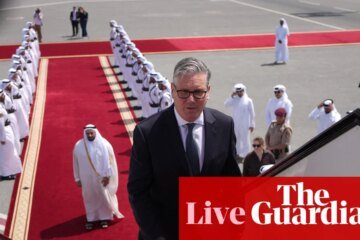
Starmer is due to return to the UK today after visiting allies in the Gulf for talks on how to support the US-Iran ceasefire and secure a permanent reopening of the strait of Hormuz. After travelling to Bahrain, Saudi Arabia and the UAE, his last stop is Qatar.
You can follow our UK politics blog where my colleague Andrew Sparrow is reporting the latest on the impact of war on the UK and other related news:
Pictures: Islamabad on high alert ahead of talks between Iranian and US negotiators
The UN children’s agency, Unicef, reported that nearly 600 children have been killed or injured in Lebanon since the outbreak of the latest Israel-Hezbollah war on 2 March.
More than 30 children were killed and nearly 150 injured by the wave of bombings carried out on Wednesday by Israeli troops, Unicef said.
In a statement, the agency said:
double quotation mark Unicef is receiving reports of children being pulled from under the rubble, while others remain missing and separated from their families. Many are experiencing trauma, having lost loved ones, their homes, and any sense of safety. Across the country, more than one million people have been uprooted, including an estimated 390,000 children, many for the second, third, or even fourth time.International humanitarian law is clear: civilians, including children, must be protected at all times.
The Israeli military has repeated the claim that Hezbollah is using ambulances for military purposes.
In a post on X, Avichay Adraee, the Arabic-language spokesperson for the Israel Defense Forces (IDF), accused Hezbollah of making “extensive military use” of ambulances, without providing evidence.
A few weeks ago, my colleague, William Christou, spoke to medics in Lebanon, visited destroyed medical centres and inspected damaged ambulances to explore the IDF’s claim. He found that none of the sites showed signs of military use. Lebanese healthcare workers and officials say Israel is deliberately targeting medical workers and facilities, including through the use of double-tap strikes. You can read the report here:
Spain’s foreign minister, José Manuel Albares, said he urged his Iranian counterpart, Abbas Araghchi, to negotiate “in good faith” during talks with the US in Islamabad.
Albares said he spoke to Araghchi “the day before yesterday” and had asked him to halt “all missile and drone launches”.
“I encourage Iran – this is what I conveyed to the Iranian foreign minister – to take part in those negotiations and to participate in good faith,” he said, according to the AFP news agency.
He again condemned Israel over its continued strikes on Lebanon, saying the attacks were a “disgrace on the conscience of humanity”.
He added: “The level of violence, the violation of international law and international humanitarian law by Israel is unacceptable.”
UK defence minister Luke Pollard said there is no truth in Donald Trump’s claims that the Royal Navy is “too old” and that its aircraft carriers “don’t work” and are “toys”.
“We’ve got a strong Royal Navy,” he told BBC Breakfast.
“HMS Sutherland, the Type 23 frigate behind me here, is crewed by brilliant men and women. We’ve got a globally deployed navy at the moment.”
Pollard added that the UK has a “unique convening role” that it can use to bring its friends and allies together to work out solutions to reopen the strait of Hormuz.
Pakistan’s defence minister, Khawaja Asif, has deleted a post on X in which he called Israel “cancerous” and a “curse for humanity”.
The post appeared on X last night but has since been deleted, Reuters news agency reported.
In the post, Asif wrote that as “peace talks are underway in Islamabad, genocide is being committed in Lebanon”. He added that “innocent citizens are being killed by Israel, first Gaza, then Iran and now Lebanon, bloodletting continues unabated”.
The Israeli prime minister’s office said the remarks were “outrageous”. In a post on X, it said: “This is not a statement that can be tolerated from any government, especially not from one that claims to be a neutral arbiter for peace.”
Israeli military chief: ‘IDF is in a state of war’
The Israel Defense Forces (IDF) chief of staff, Eyal Zamir, said Israeli forces are continuing their combat operations in southern Lebanon and are “not in a ceasefire” with Hezbollah, according to remarks released by the IDF.
During a visit near Bint Jbeil in southern Lebanon, Zamir said:
double quotation mark The IDF is in a state of war, we are not in a ceasefire, we continue to fight here in this sector, this is our main fighting sector. In Iran, we are in a ceasefire, and we can return to fighting there at any moment, and in a very powerful manner.
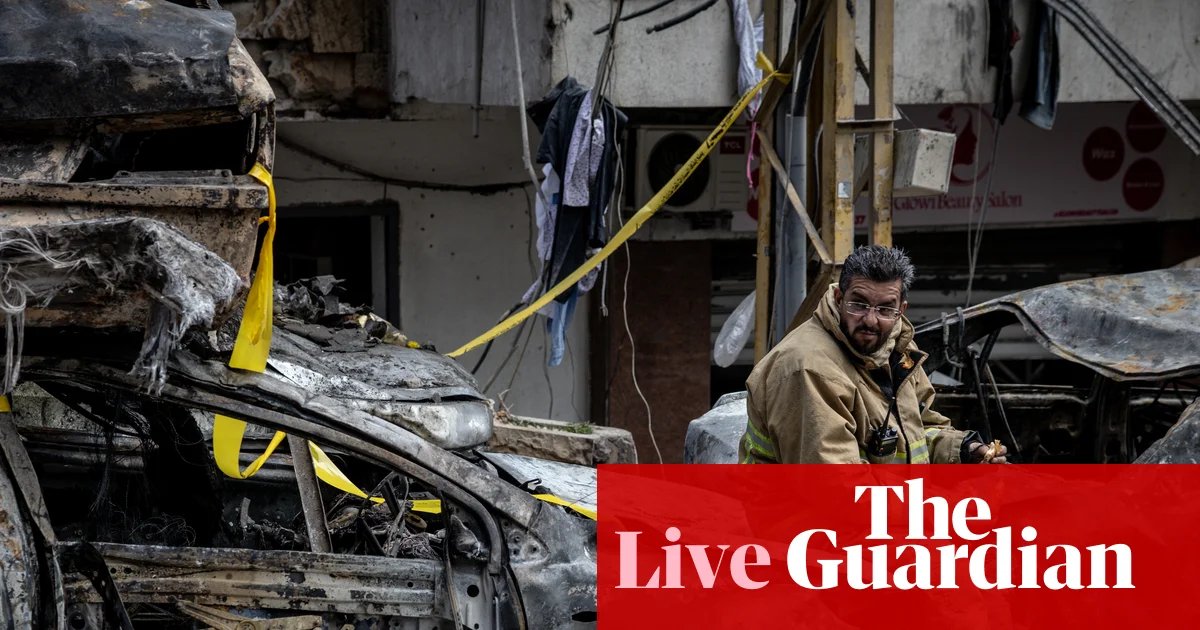
An intense wave of Israeli airstrikes in Lebanon on Wednesday killed more than 300 people, according to Lebanese authorities, making it the deadliest day for the country since the recent bout of fighting between Israel and Hezbollah began on 2 March.
Several world leaders, including the UK, have condemned Israel’s strikes and have called for Lebanon to be included in the US-Iran ceasefire.
Volodymyr Zelenskyy said Ukrainian teams deployed to the Middle East to bolster air defences in the region have shot down Iranian Shahed drones.
“We demonstrated to some countries how to work with interceptors,” the Ukrainian president said in a post on X.
“Did we destroy Iranian “shaheds?” Yes, we did. Did we do it in just one country? No, in several. And in my view, this is a success.”
Zelenskyy said Ukrainian forces took part in active operations using domestically produced, battle-tested interceptor drones.
“This was not about a training mission or exercises, but about support in building a modern air defence system that can actually work,” he added.
Iranian officials arrive in Islamabad for ceasefire talks – report
An Iranian delegation arrived in the Pakistani capital Islamabad last night for mediated talks with the US, the Wall Street Journal reported, citing people familiar with the matter.
The delegation is led by the Iranian foreign minister, Abbas Araghchi, and parliament speaker, Mohammad Bagher Ghalibaf, according to the report.
Iran’s semi-official Tasnim news agency has reported that news of Iranian officials arriving in Islamabad to negotiate with the US “is completely false”. Other state-affiliated media in Iran have also reported such denials.
US vice-president JD Vance is expected to lead the US delegation. He will be joined by US special envoy Steve Witkoff and Donald Trump’s son-in-law Jared Kushner, both of whom took part in three rounds of indirect nuclear talks with Iranian negotiators in Oman before the US and Israel launched attacks against Iran on 28 February.
Iran is taking steps to keep control over maritime traffic through the strait of Hormuz in order to exert pressure on the US, thinktank the Institute for the Study of War (ISW) has said.
The effect is that oil prices will remain high so that Iran goes into upcoming negotiations with the US with more leverage to extract concessions, ISW reports.
According to ISW, Iranian officials have said Iran will not allow more than 15 vessels per day to transit through the strait. Prior to the war, up to 140 vessels a day travelled through the strait.
double quotation mark The Iranian Ports and Maritime Organization published a graphic on April 8 instructing ships to follow designated entry and exit routes in coordination with the Islamic Revolutionary Guards Corps (IRGC) Navy to transit the strait. These routes move international maritime traffic into Iranian-controlled waters. The graphic warns that ships risk hitting mines outside of these routes.”
Indonesia has said it has submitted a joint statement on peacekeeper security with dozens of allied nations to the United Nations after three of its blue helmets were killed in Lebanon.
In the joint statement, the countries urged the UN Security Council to conduct a thorough investigation into the incidents in southern Lebanon that killed three Indonesian peacekeepers and wounded several others, including from France, Ghana, Nepal, and Poland.
The foreign ministry in Jakarta said 73 countries and UN observer nations supported the statement, delivered by Indonesia’s permanent representative to the UN, Umar Hadi, in New York.
“The safety and security of UN peacekeepers are non-negotiable. We urge the UN Security Council to use all available instruments to strengthen protection for peacekeeping forces amid an increasingly dangerous situation,” the ministry quoted Umar as saying.
“Troop-contributing countries also call for an end to violence in Lebanon, de-escalation of tensions, and encourage all parties to return to the negotiating table to achieve a peaceful settlement,” it added.
Three Indonesian peacekeepers died in two separate blasts in southern Lebanon in late March. A third blast less than a week later – inside a UN facility in southern Lebanon – injured three more Indonesian soldiers.
JD Vance heads to Pakistan this week with orders from Donald Trump to turn the shaky Iran ceasefire into a lasting peace deal.
For the 41-year-old Vance, who has kept a notably low profile during the Middle East conflict, it will be one of the biggest moments of his career. But the man widely regarded as a leading contender in the 2028 US presidential election will face huge challenges too when talks begin Saturday in Islamabad.
“I cannot think of a case where the vice president ran formal negotiations like this,” Aaron Wolf Mannes, a lecturer at the University of Maryland School of Public Policy and an expert on the American vice presidency’s role in foreign policy, told the AFP news agency.
double quotation mark This is high risk, high reward.”
Vance built his political brand as an avowed anti-interventionist who wanted to keep America out of any more foreign wars. That has made for a difficult balancing act after Trump launched the Iran war.
The New York Times reported this week that in discussions behind closed doors in the weeks before the war, Vance argued against military action, saying it could cause regional chaos and split Trump’s Maga coalition.
But Vance now suddenly finds himself as Trump’s diplomatic closer for an Iran deal.
Vance will be accompanied by special envoy Steve Witkoff and Trump’s son-in-law Jared Kushner.
One theory of why the vice-president is leading these efforts is that the Iranians may view him as a more likely partner for diplomacy, given his widely reported opposition to the war and general doubts about US interventionism.
“If he can get something that papers it over without dealing with real issues, that’s probably enough,” says Mannes.
double quotation mark But if nothing good comes of this, it raises questions about his competence, which is not going to help him electorally. And of course Rubio’s right there as a potential rival for 2028.”