Middle East crisis live: Israel orders people to flee as it warns of further strikes on Lebanon | US-Israel war on Iran
IDF orders people to flee homes in Beirut as it warns of further strikes
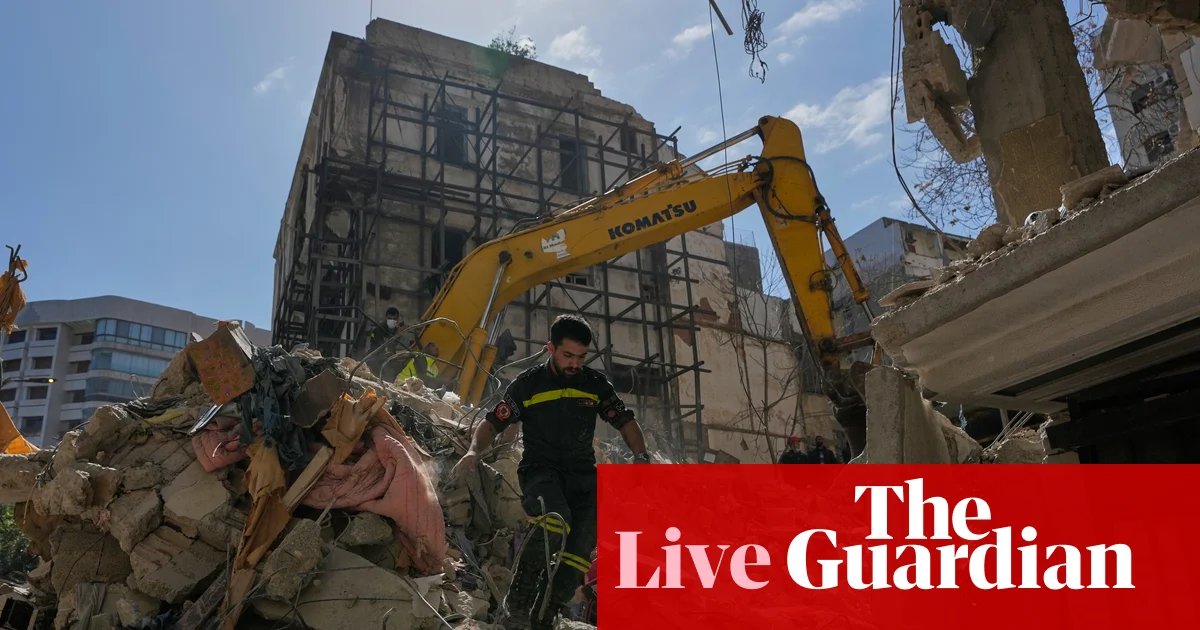
The Israeli military has again ordered people to flee their homes in the southern suburbs of Beirut, as it warned of more strikes that have already devastated the Lebanese capital.
“Urgent warning to residents of the southern suburbs of Beirut … The Israeli army is continuing its operations and striking Hezbollah military infrastructure throughout the southern suburbs,” said Avichay Adraee, an Arabic-language spokesperson of the Israel Defense Forces (IDF).
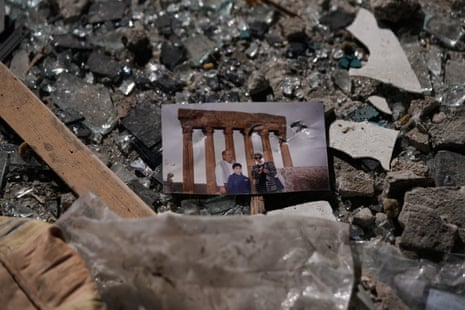
Israeli strikes yesterday killed more than 200 people and wounded 1,100 others, according to Lebanese authorities. The IDF said it targeted sites of the Iran-backed Hezbollah militant group, but Associated Press reported that several strikes hit densely packed commercial and residential areas without warning during rush hour, leading to widespread civilian casualties.
Key events

Jakub Krupa
Merz also said he did not want the US-Israeli campaign in Iran to “split” Nato or put further pressure on the relations between the US and its European allies, as he suggested Germany could play a role in securing the strait of Hormuz.
Responding to Trump’s recent criticism of the alliance, Merz said that “we do not want – I do not want – a split in Nato,” and cautioned against the war putting “further strain” on relations between the US and European Nato partners.
“Nato is a guarantor of our security, including and above all in Europe,” he stressed.
He also played down the risk of withdrawal or restriction of US troops stationing in Germany, after media suggestions that Trump was mulling such a move.
Russia said that the Middle East war ceasefire announced by the United States and Iran must cover Lebanon, after Israel announced it would continue its attacks on Iran-backed Hezbollah there.
Russian foreign minister Sergei Lavrov hailed the ceasefire in a phone call with Iranian counterpart Abbas Araghchi, with the ministry saying in a read-out that “Moscow firmly believes that these agreements… have a regional dimension and, in particular, apply to Lebanon”.
In a separate statement, the ministry’s spokeswoman Maria Zakharova condemned Israeli attacks on Lebanon, saying that “such aggressive actions threaten to derail the emerging negotiation process”.
Jakub Krupa
German chancellor Friedrich Merz has said he hoped for “a negotiated solution” to the Iran war, stressing that Germany has a fundamental interest in resolving the conflict.
Speaking in Berlin, Merz said that “the threat of a massive escalation … has been averted, at least for now,” but warned that the existing ceasefire was “fragile.”
He stressed that the conflict will have a significant impact on the world’s economy as markets remain “very tense,” stressing that Germany will “support the diplomatic process wherever and however possible.”
Merz said that speaking to Trump last night, he “encouraged” the US president to pursue negotiations with Iran “seriously,” and offered Germany’s help to secure freedom of navigation in the strait of Hormuz.
But he stressed that any such missions would “ideally” have the backing of the UN Security Council and of the German parliament, so “no decisions are to be expected within a few days.”
The German chancellor also warned about the “severity” of Israeli attacks on Lebanon, warning they could “derail the entire peace process and that must not be allowed to happen.”
The International Monetary Fund expects to have to provide up to $50 billion in immediate financial assistance to countries affected by the Middle East war, its managing director said, with the crisis likely to have lasting economic effects.
“Given the spillovers of the Middle East war, we expect near-term demand for IMF balance-of-payments support to rise to somewhere between $20bn and $50bn, with the lower bound prevailing if the ceasefire holds,” Kristalina Georgieva said, according to prepared remarks shared with AFP.
The IMF chief also highlighted the ripple effects of the crisis, including food insecurity for at least 45 million people.
Pakistani prime minister Shehbaz Sharif condemned Israel’s “ongoing aggression against Lebanon” on Thursday, ahead of expected US-Iran talks in Islamabad.
“The prime minister said that Pakistan was engaged in sincere efforts for regional peace and it was in this spirit that the peace talks between Iran and the US were being convened,” Sharif’s office said in a statement.
‘There’s no Hezbollah here’: the Lebanese reaction to Israeli strikes that killed hundreds
Omar Rakha heard the war planes but did not feel the explosions; it was only when he woke up face down on the street, bleeding, that he understood what had happened. The building next to his in the Barbour neighbourhood of central Beirut had been destroyed by two Israeli bombs – he then ran through the flaming wreckage to find his sister, screaming.
“I really didn’t think something like this would happen here. Nothing like this happened in the last war,” he said.
Rakha and other locals in the Lebanese capital have spoken to my colleague William Christou in Beirut, where they say the Israeli strikes have mainly killed civilians.
Shaden Fakih, a 24-year-old calisthenics trainer, said: “It’s getting ridiculous. There’s no Hezbollah here, the Israelis are just getting happy when they bomb people.”
You can read the full report here:
IDF orders people to flee homes in Beirut as it warns of further strikes
The Israeli military has again ordered people to flee their homes in the southern suburbs of Beirut, as it warned of more strikes that have already devastated the Lebanese capital.
“Urgent warning to residents of the southern suburbs of Beirut … The Israeli army is continuing its operations and striking Hezbollah military infrastructure throughout the southern suburbs,” said Avichay Adraee, an Arabic-language spokesperson of the Israel Defense Forces (IDF).
Israeli strikes yesterday killed more than 200 people and wounded 1,100 others, according to Lebanese authorities. The IDF said it targeted sites of the Iran-backed Hezbollah militant group, but Associated Press reported that several strikes hit densely packed commercial and residential areas without warning during rush hour, leading to widespread civilian casualties.
Trump criticises Nato in confusing Truth Social post
Donald Trump has again levelled criticism at Nato, after meeting with the alliance’s secretary general, Mark Rutte, yesterday.
Giving very little context, the US president wrote on his Truth Social app: “None of these people, including our own, very disappointing, NATO, understood anything unless they have pressure placed upon them!!!”
After their private meeting yesterday, Rutte said Trump was “clearly disappointed” that the US’s allies had refused to join its war against Iran.
Lebanese prime minister Nawaf Salam asked his Pakistani counterpart on Thursday to confirm Lebanon’s inclusion in the Iran war ceasefire, a day after Israeli strikes on the country killed more than 200 people.
In a statement, Salam’s office said he phoned Shehbaz Sharif, praising Islamabad’s efforts in securing the truce and asking him to “confirm that the ceasefire includes Lebanon to prevent a recurrence of the Israeli attacks witnessed yesterday”.
Iran to let no more than 15 vessels a day to pass strait of Hormuz
Iran will allow no more than 15 vessels a day to pass through the strait of Hormuz under the ceasefire agreement it agreed with the United States, Russia’s state TASS news agency quoted an unnamed senior Iranian source as saying.
The strait, a strip of water only 34 km (21 miles) wide between Iran and Oman, provides passage from the Gulf to the Indian Ocean and is the main route for about a fifth of world oil supplies and other vital goods including fertilisers.
It has been largely shut by Iran since the start of the conflict at the end of February, leading to a surge in global oil prices.
The speaker of the Iranian parliament, Mohammad Bagher Ghalibaf, says Lebanon forms “an inseparable part of the ceasefire” deal.
In a post on X, he said “there is no room for denial and backtracking”. His comments come after US president Donald Trump described Israel’s war with Lebanon as a “separate skirmish”.
Ghalibaf added:
double quotation mark Ceasefire violations carry explicit costs and STRONG responses.Extinguish the fire immediately.
Israeli strikes on Lebanon ‘blatant violation’ of ceasefire, says Iranian president
The Iranian president, Masoud Pezeshkian, said Israel’s strikes on Lebanon are a “blatant violation” of the US-Iran ceasefire agreement and their continuation would “render negotiations meaningless”.
A translation of his statement on X reads:
double quotation mark Israel’s renewed incursion into Lebanon is a blatant violation of the initial ceasefire agreement. This is a dangerous sign of deception and lack of commitment to potential agreements. The continuation of these actions will render negotiations meaningless. Our fingers remain on the trigger. Iran will never abandon its Lebanese sisters and brothers.
The US and Israel maintain that the two-week ceasefire does not extend to Lebanon, where the Israeli military has launched one of its heaviest barrages of airstrikes yesterday.
Iran and Pakistan, which mediated the ceasefire, say Lebanon is included.
Iran nuclear chief on restrictions to uranium enrichment: ‘US and Israel demands will not come true’
As we reported earlier (see post at 10:30) Iran’s atomic energy chief, Mohammad Eslami, said the US will “not succeed in restricting Iran’s enrichment programme”.
AFP news agency has reported further comments from Eslami, in which he says the US and Israel’s demands for Iran to cease uranium enrichment “will not come true”.
“The claims and demands of our enemies to restrict Iran’s enrichment programme are merely wishes that will be buried,” he was quoted as saying by Iran’s ISNA news agency.
Iran’s uranium enrichment capabilities remain a key point of contention in the negotiations between Tehran and Washington, with Donald Trump demanding a total halt and removal of buried nuclear “dust” – referring to Iran’s stockpile of highly enriched uranium – in exchange for sanctions relief.
The UAE defence ministry said its skies had been free of any aerial threats today.
In a post on X, the ministry said: “UAE air defence systems did not detect any ballistic missiles, cruise missiles, or UAVs (unmanned aerial vehicle) launched from Iran.”

Lisa O’Carroll
Four Iranian, four Greek and one Chinese ships are among the 11 vessels that have been allowed transit through the strait of Hormuz in the 24 hours since the ceasefire.
Their passage barely dents the blockage on both sides of the narrow passage where about 1,400 ships remain anchored.
According to data verified by AXSMarine, two eastbound ships – the Oman-owned Lucia and Greek-owned Iolcas Destiny – were given passage from the Gulf in the early hours of Thursday morning despite the Iranian declaration that the strait was closed amid concerns over the fragility of the ceasefire.
A further ship which crossed from west to east on Wednesday did not identify itself and could be part of a shadow fleet.
AXS said there was a high degree of “spoofing” and signal disruption particularly among vessels anchored in the Gulf, with many reporting false positions.
While the strait has been effectively closed since the outbreak of war, Iran has made concessions to allies including China, Russia, India, Iraq and Pakistan, with some Malaysian and Thai vessels granted access after diplomatic talks in the last six weeks.
On 2 April, Iran said it would allow Philippine-flagged vessels to cross following further negotiations.
Netanyahu after death of personal adviser to Hezbollah leader: ‘We will continue to strike them wherever necessary’
The Israeli prime minister, Benjamin Netanyahu, confirmed that IDF strikes in Lebanon killed the nephew and secretary of Hezbollah leader Naim Qassem.
In a statement on X, he said Ali Yusuf Harshi was “one of the closest people” to the militant group’s leader.
He added that the Israeli military will continue to strike Hezbollah “wherever necessary”, a day after deadly Israeli airstrikes on Lebanon.
Netanyahu said yesterday that Lebanon is not part of the ceasefire between the US and Iran, but Tehran and mediating countries have issued conflicting claims on whether the ceasefire applies to the country.