I didn’t expect to love chimp trekking as much as gorilla trekking, but this trip to Uganda changed my mind
I have had great ape experiences before, with a certain hierarchy already in my head. Gorilla trekking, I assumed, would always be the apex moment: the one people talk about in subdued, almost reverent tones, the one that rearranges your perception of travel, wildlife, and privilege all at once. Chimp trekking, by comparison, sat in my imagination as something more secondary, more frantic, maybe even less emotionally evocative.
I was wrong.
In Kibale, chimp trekking was less like a supporting act and more like a completely different kind of thrill, one that was louder, faster, more unpredictable, and, in its own way, just as moving. The experience took place at a different rhythm from gorilla trekking. Gorillas often feel solemn, grounded, almost regal. By contrast, chimpanzees seem electric, and you hear them before you fully see them. You catch motion high in the canopy, then a burst of sound, then a flash of limbs, and suddenly the forest is not quiet at all, still alive with personality.
That surprise, that I could love this as deeply as gorilla trekking, not instead of it but alongside it, became one of the defining memories of my time in Uganda.
What is chimp trekking in Kibale actually like?

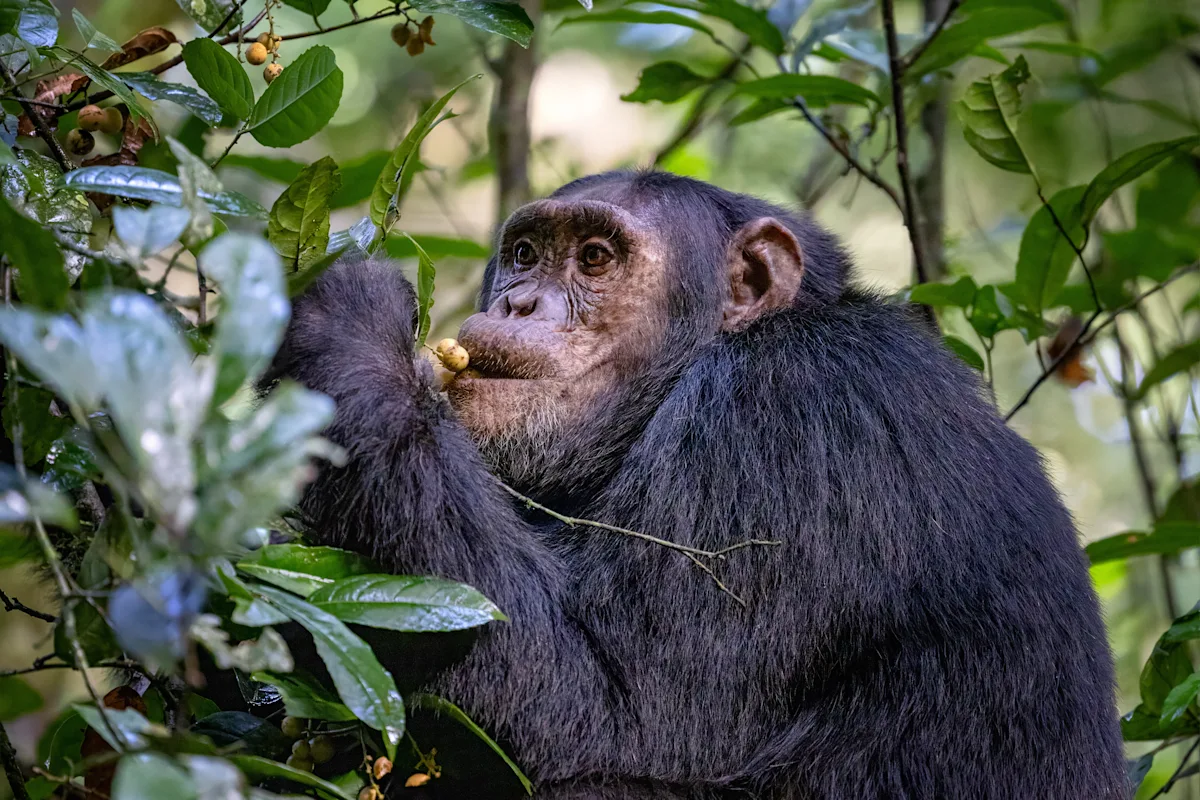
A chimpanzee spotted during a guided trek in Kibale National Park, one of Uganda’s top primate destinations, easily accessed through curated experiences by Volcanoes Safaris.
(Volcanoes Safaris)
Kibale National Park is one of Uganda’s best-known places for chimpanzee trekking and is home to around 1,500 chimpanzees and exceptional primate diversity. Guided chimp treks in Kibale typically begin at the Kanyanchu Visitor Centre, usually at 8 a.m., 11 a.m., or 2 p.m., last about two to five hours depending on where the chimps are, and allow visitors one hour with the animals once they are found.
That sounds tidy on paper, but in practice, it feels far more alive than any neat itinerary can capture. The expectation builds quickly as you move through the dense forest, listening hard, following the ranger’s cues, trying to read the landscape. Then, once you find them, the whole mood changes. Chimpanzees do not hold still for your benefit, and being in the forest with them was similar to being in my son’s preschool class: they move, shriek, groom, forage, swing, posture, and vanish and reappear in ways that make the interaction seem dynamic rather than posed, and give off complete toddler energy in the best way. That, for me, was the magic of it because, while gorilla trekking can feel almost meditative, chimp trekking felt charged.
One of the most eye-opening parts of my time around Kibale was also spending time on a more conservation-focused chimp experience, which helped me fully understand the difference between chimpanzees that are more accustomed to human presence and those that are still in a more transitional stage, and the contrast was striking. Even without romanticizing it, you could see how much temperament, movement, and group behavior shifted depending on how comfortable the chimps were with observers. It added an entirely different layer to the trek, making the experience feel less like simple wildlife viewing and more like an education in behavior, adaptation, and the long, careful work behind ethical primate tourism.
Is chimp trekking easier than gorilla trekking?

A lively group of chimpanzees moves through the forest floor in Kibale, showcasing the dynamic and energetic wildlife encounters that define chimp trekking with Volcanoes Safaris.
(Volcanoes Safaris)
Generally, yes, it is, though “easier” is relative.
In my experience, chimp trekking in Kibale usually requires a bit less fitness than many gorilla treks, especially for travelers nervous about the steep, mountainous terrain often associated with gorilla trekking in places like Bwindi. In my experience, Kibale chimp treks are forest walks of roughly two to five hours, while steep ridges and deep valleys, as in my gorilla trekking experience in Volcanoes National Park in Rwanda, more define the experience, which helps explain why many travelers find chimp trekking more manageable. That does not mean effortless: you still need decent mobility, comfortable hiking clothes, and the willingness to move quickly when the chimps do.
For travelers who want a major primate experience but worry they are not up for an especially punishing climb, chimp trekking can feel like a more approachable entry point. It still feels adventurous and still gets your heart rate up. But it can be a better fit for people who want something active without the same level of physical intensity that many gorilla treks can demand.
What is it like to stay at Kibale Lodge?

The pool at Kibale Lodge by Volcanoes Safaris offers sweeping views toward the Rwenzori Mountains, creating a peaceful retreat after a day of chimp trekking in Kibale Forest.
(Volcanoes Safaris)
Part of what made the whole experience so memorable was having a base that was deeply connected to the landscape rather than sealed off from it. Kibale Lodge, which opened in 2024, sits on a ridge with views toward the Rwenzori Mountains and the surrounding hills near Fort Portal. Volcanoes. The lodge has eight hand-built bandas, each with a private terrace, plus a spa, sauna, pool, and personal butler service, and the chimp trekking base in Kibale Forest is about a 30-minute drive away.
What I liked most about staying at Kibale Lodge was that it never seemed interested in distracting from the reason you had come. The property is undeniably beautiful, but its luxury works best as context rather than competition. After a morning in the forest, the rhythm of returning there felt especially satisfying: back to a hand-built banda with a private terrace, indoor and outdoor showers, and long views across the rolling hills toward the Rwenzoris, then on to the spa, where complimentary massages are offered subject to availability alongside a sauna and swimming pool. The effect is restorative rather than showy. You feel taken care of, but never sealed off from the landscape that brought you here in the first place.
That connection to place is what makes the lodge memorable. Kibale Lodge has eight bandas and is just a 30-minute drive from the forest for chimpanzee trekking. Still, it also encourages guests to experience the wider Kabarole region rather than treating the park as a single-box safari stop. Official activities include chimpanzee habituation, birding in Bigodi Wetland, hikes, and visits tied to community and conservation work, including schools participating in the Roots and Shoots program run with the Jane Goodall Institute, the Rwenzori Sculpture Foundation, and local guiding initiatives on the land around the lodge.

Kibale Lodge, Volcanoes Safaris’ chimpanzee-focused retreat near Kibale National Park in western Uganda, opened on July 1, 2024, with sweeping views over the surrounding hills and crater-lake landscape.
(Volcanoes Safaris)
That community dimension turned out to be one of the most impactful parts of my stay. My favorite excursion was visiting two local schools and seeing, in a concrete way, how conservation tourism linked to the chimpanzees can help fund needed infrastructure and supplies, including a water tank. It gave the experience more depth. Kibale wasn’t only about the thrill of seeing primates in the canopy, but about understanding how a lodge like this can serve as the link between extraordinary wildlife, the surrounding hills and villages, and the people working to ensure both have a future. Volcanoes Safaris also intentionally frames that exchange: guests can participate in nearby community projects, and the lodge’s hospitality draws on Batoro traditions, including giving guests an ampaako, or pet name, during their stay.
What else should you do around Kibale besides chimp trekking?

The scenic crater lakes of the Ndali-Kasenda region near Kibale National Park add another layer to a Volcanoes Safaris itinerary, blending primate trekking with breathtaking Ugandan landscapes.
(Volcanoes Safaris)
Do not make the mistake of treating Kibale as a one-and-done primate stop. Bigodi Wetland is well worth adding for anyone interested in birds, monkeys, and a slower, more layered understanding of the ecosystem around Kibale. Lodge activities also extend to walking trails, wetland excursions, and community visits, which can help round out the emotional tempo of a stay that might otherwise revolve entirely around adrenaline and wildlife sightings.
It is also worth making time for the community side of the region, especially if you are staying at a place like Kibale Lodge, where the conservation message is not presented as an abstract concept. The Roots and Shoots connection in particular gives guests a window into how conservation, education, and local leadership intersect beyond the park gates. That mattered to me because primate travel can too easily become about the encounter alone. The more meaningful version is one that also remembers the surrounding human landscape.
What questions do travelers have before chimp trekking in Uganda?

A close encounter with a chimpanzee in Kibale Forest highlights the raw, immersive nature of chimp trekking experiences offered through Volcanoes Safaris in Uganda.
(Volcanoes Safaris)
How long does chimp trekking take?
Usually, 2 to 5 hours total for standard chimp trekking in Kibale, with 1 hour spent with the chimpanzees once found.
What about the habituation experience?
Uganda Wildlife Authority’s guidelines allow up to four hours of viewing for chimpanzee habituation experiences, and Volcanoes Safaris says this experience at Kibale is limited to six guests per day.
Is there a minimum age?
Uganda Wildlife Authority’s 2024 guidelines say the minimum age for chimp tracking and viewing is 12. Kibale Lodge separately notes that children under 15 are not permitted to track the chimps through the lodge’s programming, so families should confirm the latest rules at booking.

Hand of chimpanzee lying down on the tree in Uganda, Africa
(Ozbalci via Getty Images)
Do you need to be very fit?
You should be comfortable walking on uneven forest trails, but many travelers find chimp trekking more manageable than a gorilla trek. Terrain, weather, and how far the chimps have moved that day still make a big difference.
Is it worth doing if you have already done gorilla trekking?
Absolutely. I argue that it is when it becomes most interesting, because you stop comparing them as versions of the same thing and start appreciating how different the encounters really are.
That is probably the biggest thing I came away with. Chimp trekking did not feel like a lesser alternative to gorilla trekking, but like a parallel experience, one with its own energy, mood, and emotional pull. Gorillas may be the better-known headline, but Kibale made a convincing case that chimpanzees can deliver a story just as powerful, only in a very different voice.
And that, for me, was the unexpected part. I arrived assuming I already knew where this experience might sit in the hierarchy of great wildlife moments. I left realizing I had created a hierarchy that never really deserved to exist in the first place.